Donald Trump's Health: New Speculations After Red Mark on Neck
The health of high-profile political figures, particularly those vying for or holding the highest office, is perpetually under intense scrutiny. Every public appearance is meticulously analyzed, every perceived abnormality becomes fodder for discussion and debate. Recently, former President Donald Trump, who is campaigning for a return to the White House, found himself once again at the center of such speculation following the appearance of a noticeable red mark on his neck. This latest observation, quickly dubbed "Trump's neck spot" or "red fleck on Trump's hals" (German for neck) by some, has ignited a fresh wave of public and media curiosity, raising questions about his overall well-being as he approaches his 80th birthday.
The Latest Health Concern: A Red Mark on the Neck
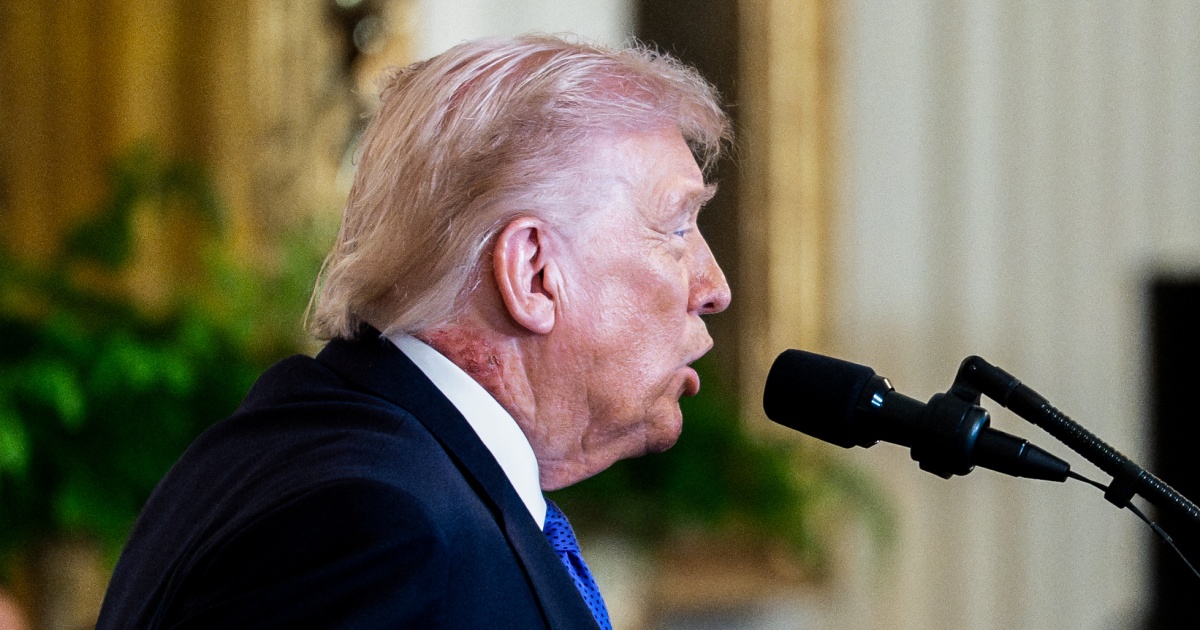
The distinctive red mark on the right side of Donald Trump's neck first garnered significant attention during a recent public appearance. Visible beneath the collar of his shirt and extending up towards his ear, the mark immediately became a talking point across social media platforms and news outlets. This wasn't an isolated incident; questions about Trump's health have surfaced repeatedly throughout his political career.
In response to the growing speculation surrounding this new observation, the White House (referencing statements made during Trump's previous presidency, or more accurately, his campaign team now speaking on his behalf) issued an official explanation. According to Dr. Sean Barbabella, described as Trump's physician, the former president is using a "common cream for the prevention of skin irritations" on the affected area. This cream, he stated, was prescribed by a doctor. The statement further indicated that Trump had been applying the cream for approximately a week, and the redness was expected to persist for several more weeks.
However, the official statement, while providing an explanation for the *treatment*, notably did not explicitly clarify the *underlying cause* of the skin irritation itself. This ambiguity left some observers unsatisfied, perpetuating the very speculation it aimed to quell. The intense focus on such a seemingly minor detail underscores the heightened public interest in the health of individuals seeking or holding the presidency, where every physical sign can be interpreted, sometimes rightly and sometimes wrongly, as an indicator of fitness for office.
Deciphering the Official Explanation: A Common Skin Irritation?
Dr. Barbabella's statement that Donald Trump is applying a "common cream for the prevention of skin irritations" offers a broad, yet somewhat vague, explanation. While reassuring in its implication that the issue is not serious, it naturally invites further questions about the nature of the irritation. What could lead to such a visible mark on the neck, especially for a prominent public figure?
Several benign dermatological conditions could result in redness or irritation on the neck. These might include:
* **Contact Dermatitis:** An allergic reaction or irritation caused by contact with certain substances, such as cologne, laundry detergent, specific fabrics (like shirt collars), or even razor burn. Given Trump's frequent wear of collared shirts and public engagements, irritation from clothing friction or shaving is a plausible, though unconfirmed, possibility.
* **Sun Exposure:** Prolonged or unprotected sun exposure can lead to sunburn or, over time, various forms of actinic damage. While less likely to appear as a singular, localized red mark, chronic sun exposure is a common cause of skin issues in older individuals.
* **Minor Infection:** Bacterial or fungal infections can manifest as localized redness and irritation, though these often come with additional symptoms like itching or pain.
* **Folliculitis:** Inflammation of hair follicles, often appearing as small red bumps, which can sometimes coalesce into a red patch.
The phrase "prevention of skin irritations" suggests a prophylactic measure, perhaps a barrier cream or a mild anti-inflammatory agent. However, the accompanying detail that the "redness will last several weeks" implies either a persistent underlying issue being managed or a treatment for an existing, perhaps recent, irritation that requires time to heal. Without more specific medical details, it's impossible to pinpoint the exact nature of the irritation.
For individuals, especially those with sensitive skin or who are frequently exposed to irritants, proactive skin care can be beneficial. Using hypoallergenic products, ensuring proper hygiene, and seeking prompt medical advice for any persistent or worsening skin conditions are always recommended. For public figures, however, even routine skin issues can become subjects of national discourse. For more detailed information, consider reading
Trump's Red Neck Spot: White House Reveals Doctor's Explanation.
A Pattern of Health Speculation and Explanations
The recent "trump fleck hals" incident is by no means the first time Donald Trump's health has become a focal point of public scrutiny. Throughout his political career, his team has often found itself offering explanations for various physical observations, sometimes with explanations that drew considerable skepticism.
One notable instance involved the frequent appearance of **blue spots or bruises on his hand**. These marks, particularly visible during public appearances, prompted a flurry of speculation. The explanations offered varied widely, at times appearing somewhat improvised:
* Initial claims suggested the bruises were a benign side effect of **vigorous handshaking**.
* Later, Trump himself attributed some of the marks to simply **bumping into a table**.
* Another explanation cited a **high-five with Attorney General Pam Bondi**, suggesting an enthusiastic gesture might have led to bruising.
* Significantly, Trump also linked the bruising to his **regular use of Aspirin**, a common blood thinner prescribed for heart health. He famously remarked, "Take Aspirin if you love your heart, but don't take Aspirin if you don't want to have little blood bruises." This statement highlights the reality that blood thinners can indeed increase the propensity for bruising, particularly in older individuals. For those on blood thinners, any new or unusual bruising should always be discussed with a healthcare professional.
It was also observed that these spots were often **concealed with makeup** during public engagements, further fueling the perception that his team was attempting to manage his public image carefully.
Beyond skin marks, Trump's public appearances also led to observations of him with **closed eyes** during various events. Critics often suggested he was dozing off, a charge he vehemently denied, attributing these moments to either deep relaxation or simply boredom. This stands in stark contrast to his frequent criticism of his successor, Joe Biden, whom he often derided as "Sleepy Joe," implying a lack of energy or mental acuity.
Furthermore, there was a brief period of confusion regarding medical tests. Trump initially mentioned undergoing an **MRI** (Magnetic Resonance Imaging) in October 2025 – a future date, possibly a misstatement or typo in reporting – for a comprehensive health check. However, this was later clarified by Dr. Barbabella, who confirmed that it was actually a **CT scan** (Computed Tomography), not an MRI. The purpose of this CT scan, according to Barbabella, was to "definitively rule out any cardiovascular problems." CT scans are often quicker than MRIs and are excellent for quickly assessing bone and some soft tissues, including vascular structures and calcifications indicative of heart disease. This clarification, while important, added another layer to the narrative of health-related clarifications from his team. To delve deeper into these health discussions, you can read
Unpacking Trump's Neck Spot: Health Speculation and Explanations.
The Public Eye and Presidential Health: Why it Matters
The intense scrutiny of a presidential candidate's or sitting president's health is not merely a matter of idle curiosity; it’s a critical component of public trust and national stability. Donald Trump, as the oldest elected US President, turning 80 in June, faces an even more magnified level of examination regarding his physical and mental fitness.
The health of a world leader directly impacts their capacity to endure the immense pressures of the office, make sound judgments, and perform the rigorous duties required. From a national security perspective, a president's health is paramount; any perceived weakness or illness could be exploited by adversaries or create uncertainty on the global stage.
For politicians, striking a balance between privacy and transparency regarding health information is a perennial challenge. While individuals are entitled to a degree of medical privacy, the public has a legitimate interest in knowing that their leader is healthy enough to govern effectively. This dynamic often leads to situations where even minor physical observations, such as a "trump fleck hals," become magnified into significant talking points.
In the realm of political campaigns, health concerns can also be weaponized by opponents, creating narratives around fitness and stamina. Conversely, perceived vigor and resilience can be assets. This makes the management of a candidate's public image, including their physical presentation, a crucial strategic element. The public's perception, often shaped by what they see and hear, plays a significant role in electoral outcomes and political discourse.
Conclusion
The appearance of a red mark on Donald Trump's neck has once again propelled his health into the national conversation, serving as another example of the intense scrutiny faced by prominent political figures. While his medical team has provided an explanation, attributing it to the use of a common cream for skin irritation, the incident highlights the ongoing public interest in the former president's well-being. This latest "trump fleck hals" event follows a pattern of past health-related observations and subsequent explanations, from blue spots on his hand attributed to aspirin and various bumps, to clarifications regarding medical scans. As Trump continues his campaign, every physical detail will undoubtedly be observed and analyzed, underscoring the enduring significance of a leader's perceived health in the public eye and the political arena.